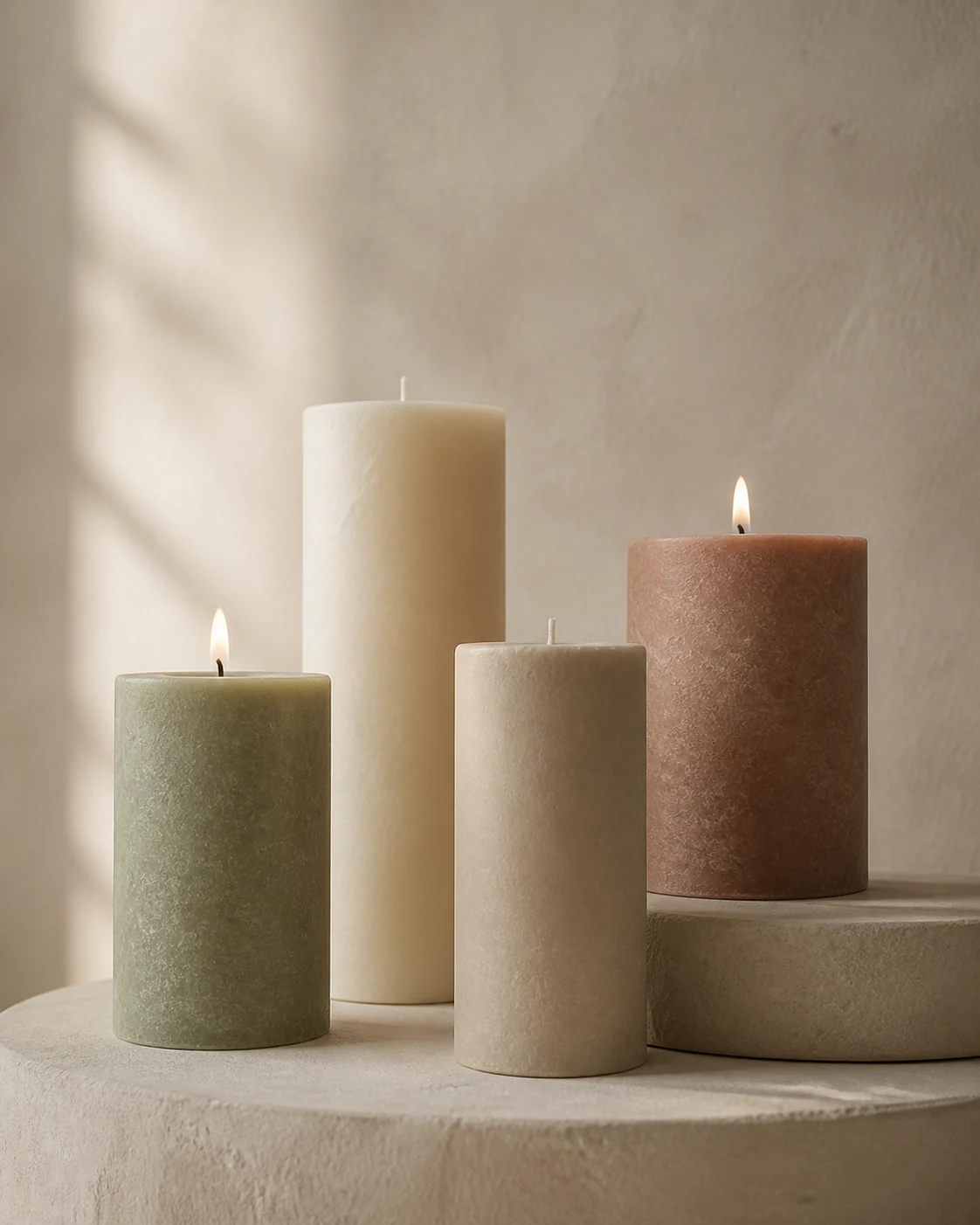
Wax is more than the fuel inside a candle. It affects surface finish, color, fragrance delivery, burn behavior, production method and price. Soy wax, beeswax, palm wax and paraffin can all make excellent candles, but they do not perform in exactly the same way. The right choice depends on the candle format, desired aesthetic, target market and technical requirements.
What does candle wax actually do?
When a candle is lit, heat from the flame melts a small pool of wax around the wick. The wick draws this liquid upward, where it vaporizes and burns. A successful candle therefore depends on the relationship between wax, wick, fragrance, dye, vessel and candle dimensions. Changing the wax often requires the wick and fragrance loading to be tested again.
Melting point is only one part of the story. Manufacturers also evaluate hardness, shrinkage, adhesion to glass, oil-binding capacity, crystallization, color stability and ease of release from a mold. These characteristics explain why a wax that performs beautifully in a container candle may be unsuitable for a freestanding pillar or detailed sculptural shape.
Soy wax: soft, creamy and popular for container candles
Soy wax is made from hydrogenated soybean oil. It is a plant-derived material with a relatively soft texture and a low-to-moderate melting range, although its exact properties vary by grade and blend. Its opaque, creamy appearance is especially popular in minimalist scented candles.
Soy wax is commonly selected for jars, tins and other container candles because it usually adheres reasonably well to a vessel and forms a broad melt pool. It can provide good fragrance performance when the wax, fragrance oil and wick are properly matched. Freestanding shapes may require a harder pillar-grade soy wax or a blend with another material.
- Best suited to: scented container candles, tins and soft-finish lifestyle collections.
- Advantages: plant-derived positioning, creamy appearance and good suitability for containers.
- Points to manage: frosting, uneven tops, sensitivity to temperature changes and softer structure.
The white crystalline marks known as frosting are common in soy wax and do not normally prevent the candle from burning. Careful cooling, stable storage temperatures and an appropriate formulation can reduce their appearance, but buyers should agree on an acceptable visual standard before production.
Beeswax: naturally aromatic and structurally firm
Beeswax is produced by honeybees to build honeycomb. After collection and filtration, it may range from golden yellow to pale ivory depending on refinement and source. Natural beeswax often carries a subtle honey-like aroma, which can influence the final fragrance profile.
Its relatively firm structure makes beeswax suitable for tapers, pillars, molded candles and rolled honeycomb sheets. It is also used in blends to increase hardness or modify burn behavior. Because beeswax is an animal-derived agricultural material, color and aroma may vary between batches more than highly refined industrial waxes.
- Best suited to: tapers, pillars, molded candles and premium natural-material collections.
- Advantages: firm body, distinctive natural character and warm color options.
- Points to manage: higher material cost, batch variation and possible interaction with added fragrance.
Claims such as “100% beeswax” should be supported by a clear material specification. If scent consistency or a pale color is essential, request a sample from the intended production batch rather than relying only on a reference photo.
Palm wax: hard wax with decorative crystal effects
Palm wax is derived from palm oil fractions and is known for its hardness and distinctive crystalline surface patterns. Depending on formulation and cooling conditions, it can create feathered, frosted or star-like textures that become part of the candle design.
Its rigidity and mold release make palm wax useful for pillars and molded candles. Processing temperature and cooling rate require careful control because they affect crystallization, surface appearance and the way the candle burns. Palm wax may also be blended to adjust hardness and texture.
- Best suited to: pillars, votives and molded candles with decorative crystalline surfaces.
- Advantages: hard structure, good mold release and distinctive visual effects.
- Points to manage: controlled cooling, possible surface variation and responsible sourcing.
Palm production can be associated with land-use and supply-chain concerns. Buyers seeking verified responsible sourcing should define the certification or traceability documents they require and confirm that the selected grade and supplier can provide them.
Paraffin wax: versatile, consistent and widely used
Paraffin wax is a refined petroleum-derived wax available in many melting points and hardness levels. Its consistency, broad availability and compatibility with fragrance and color have made it one of the most widely used candle materials.
Different grades can be formulated for containers, pillars, tapers, votives and highly detailed molded candles. Paraffin generally accepts dye well and can deliver strong fragrance performance, while its predictable processing behavior supports efficient high-volume production. Blends and additives are often used to fine-tune opacity, hardness, shrinkage and surface finish.
- Best suited to: almost every candle format, especially colored, fragranced and detailed designs.
- Advantages: versatility, consistency, strong color options and cost efficiency.
- Points to manage: petroleum-derived positioning and the need for proper wick and formulation testing.
A candle's soot level cannot be judged from wax type alone. An oversized or untrimmed wick, excessive fragrance, drafts and a long unbroken burn can all increase visible soot. Product testing and clear care instructions matter for every wax system.
Quick comparison: which wax fits which product?
- For a creamy scented jar candle: container-grade soy wax or a soy-based blend is a common starting point.
- For a premium natural taper: beeswax offers firmness and recognizable material character.
- For a crystalline decorative pillar: palm wax is valued for its patterned surface.
- For vivid colors or complex molded shapes: paraffin offers flexibility and repeatable production.
- For balanced performance: blended waxes can combine hardness, adhesion, fragrance delivery and appearance.
There is no universally “best” candle wax. A technically successful material is one that meets the required look, fragrance experience, safety performance, price and sourcing expectations in the chosen candle format.
Why wax blends are so common
Commercial candles frequently use blends rather than a single wax. A manufacturer may combine waxes to improve glass adhesion, reduce brittleness, increase hardness, enhance fragrance delivery or achieve a particular surface. A “soy candle,” for example, may use a soy-dominant blend unless the specification explicitly requires 100% soy wax.
Buyers should define which claims must appear on the label and ask for the corresponding composition statement. Terms such as natural, plant-based and clean-burning may be interpreted differently across markets, so packaging claims should be reviewed against the regulations and advertising rules of the destination country.
Questions to ask before placing an order
- Is the wax a single material or a blend, and what composition claim can be supported?
- Is the grade designed for containers, pillars, tapers or molded shapes?
- What fragrance load and wick series were used in the approved sample?
- How will color, frosting, crystallization, shrinkage and surface variation be evaluated?
- Which burn tests and market-specific safety standards are required?
- Are material origin, certification or traceability documents needed?
- What storage temperature and shelf-life guidance applies to the finished candles?
A practical sourcing principle
Approve the complete candle system—not wax in isolation. Final testing should use the production wax, fragrance, dye, wick, vessel or mold, packaging and intended burn instructions. Even a small change to one component can affect performance.